
Top 10 Compostable Food Packaging Manufacturers in China
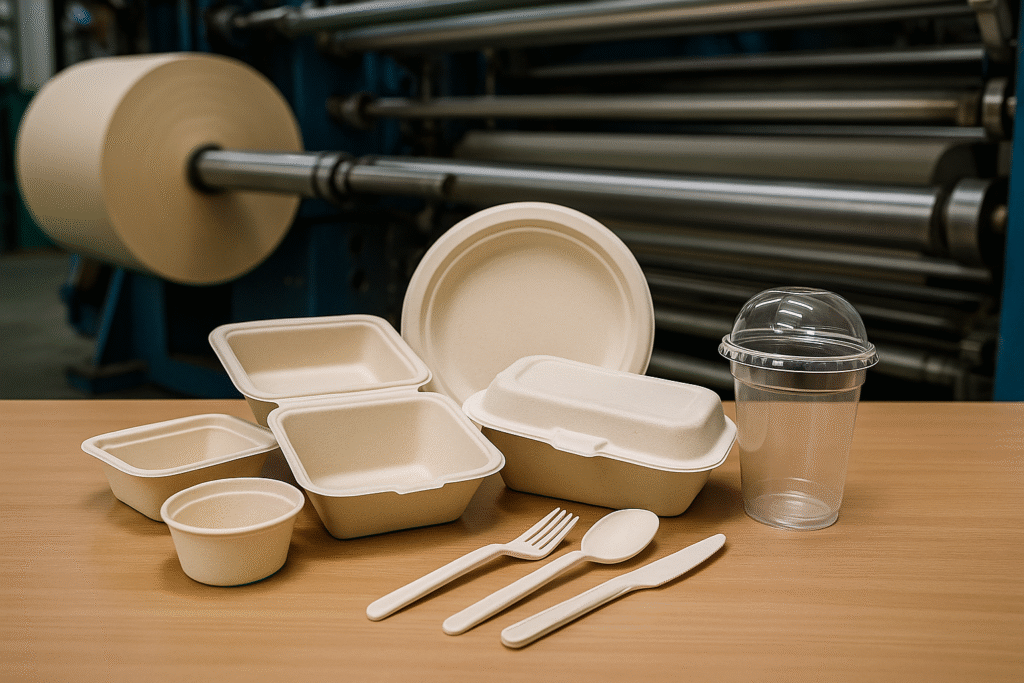
As sustainability becomes the defining standard for global packaging, compostable food packaging has emerged as the most viable pathway toward a plastic-free future.
From fast-food chains to premium ready-meal brands, companies are now demanding packaging that is not only functional and safe but also capable of returning to nature — without leaving toxic traces.
According to China Packaging Sustainability Outlook 2025, global demand for compostable packaging is growing at 19% annually, with China supplying nearly 70% of worldwide exports.
Brands like Bioleader have become key players in this transformation, offering high-performance, PFAS-free compostable packaging solutions made from sugarcane bagasse and PLA.
Understanding Compostable Food Packaging
What Makes Packaging Compostable?
Compostable food packaging is designed to biodegrade into organic matter under specific composting conditions, typically within 90 to 180 days.
Unlike traditional plastics, these materials break down completely — producing water, CO₂, and nutrient-rich biomass without releasing harmful residues.
Core Material Types
| Material | Compostability | Temperature Range | Main Advantages | Typical Uses |
| Bagasse (Sugarcane Fiber) | ✅ 100% Compostable | -20°C to 120°C | Microwave & freezer safe, high rigidity | Bowls, trays, clamshells |
| PLA (Polylactic Acid) | ✅ 100% Compostable | Up to 50°C | Transparent, ideal for cold drinks | Cups, lids, straws |
| Kraft Paper | ♻️ Recyclable | Up to 90°C | Natural aesthetic, customizable printing | Takeaway boxes, bags |
| Cornstarch Blend | ⚪ Partial | Up to 100°C | Affordable entry-level eco alternative | Cutlery, plates |
Bagasse packaging, such as bagasse food packaging, has gained prominence for its versatility, compostability, and alignment with international food-contact safety standards (EN13432, ASTM D6400, and BPI).
Why China Leads the Compostable Packaging Revolution
China’s dominance in compostable packaging is rooted in three major strengths:
- Integrated Manufacturing Ecosystems: From raw bagasse pulp processing to automated molding lines.
- Global Certifications: Most top manufacturers hold BPI, LFGB, and EN13432 compliance.
- Cost-to-Performance Advantage: Efficient logistics and economies of scale make exports cost-competitive for Western buyers.
Top 10 Compostable Food Packaging Manufacturers in China
Below is the 2025 ranking of China’s top manufacturers, based on production scale, innovation, global certifications, and export performance.
| Rank | Company | Main Products | Material | Core Strength | Export Market |
| 1 | Bioleader | Bagasse & PLA Packaging | Bagasse, PLA | PFAS-free, certified, export-focused | U.K., EU, U.S. |
| 2 | GreenPack Industrial | Paper & Bagasse Boxes | Kraft, Bagasse | FSC-certified, high automation | SEA |
| 3 | EcoMold Packaging | Fiber Trays & Lids | Bagasse, Bamboo | ISO-certified molds | Japan |
| 4 | NewEra BioTech | PLA Cups & Straws | PLA | Proprietary polymer R&D | Europe |
| 5 | Packwin Group | Kraft Bowls & Boxes | Paper | Publicly listed, high throughput | U.S. |
| 6 | Huadi Eco Tableware | Bagasse Clamshells | Bagasse | PFAS-free coating | Middle East |
| 7 | Yuhang Environmental | PLA Lunch Boxes | PLA, PP | Robotics-driven automation | Institutional |
| 8 | Foshan GreenWorks | Takeaway Paper Boxes | Paper, Bagasse | Design innovation | Domestic |
| 9 | Xuzhou BioPro | Cornstarch Containers | Cornstarch | Cost-effective SME supplier | Local markets |
| 10 | Zhongbao Packaging | Recycled Paper Boxes | Recycled Paper | Low-carbon focus | China region |
#1 Bioleader (Xiamen Bioleader Environmental Protection Technology Co., Ltd.)
Founded in Xiamen, Fujian, Bioleader is a benchmark for sustainable food packaging in China.
The company specializes in bagasse pulp molding and PLA biodegradable products, combining renewable agricultural residues with advanced molding technology.
Its flagship range includes biodegradable food packaging, trays, clamshells, bowls, and clear PLA cups.
All are fully compliant with EN13432, ASTM D6400, BPI, FDA, and LFGB standards, and notably free from PFAS, PFOA, and PFOS — substances increasingly banned in the EU and U.S.
Bioleader’s Edge:
- Scale: 20,000+ m² factory with automated lines producing over 1 billion units annually
- Export Reach: Over 60 countries including the U.K., Germany, and Canada
- Innovation: Proprietary PFAS-free coating for enhanced grease resistance
- Client Base: Meal-kit providers, airline catering, and national QSR chains
“Our goal is to make sustainability accessible to every brand,” says Junso Zhang, Marketing Director. “We believe compostable packaging is not just a regulatory response — it’s a business advantage.”
Company Details:
Website: www.bioleaderpack.com
Address: No.39 Xinglong Road, Xiamen, Fujian, China
Contact: Junso Zhang (Mr.)
#2 GreenPack Industrial Co., Ltd.
Based in Zhejiang, GreenPack Industrial focuses on paper and bagasse takeaway boxes.
The company’s high-speed production and FSC-certified materials make it a preferred supplier for foodservice chains in Southeast Asia.
Scale: 500+ employees
Strength: Integrated printing and forming lines
Weakness: Limited range in PLA packaging
#3 EcoMold Packaging Co., Ltd.
Guangdong-based EcoMold specializes in fiber trays and lids made from bagasse and bamboo pulp.
The firm is recognized for ISO14001 compliance and precision mold technology suited for airline catering.
Advantage: Rigid, microwave-safe, eco-certified
Limitation: Slower lead times for export customization
#4 NewEra BioTech Materials Co., Ltd.
Shanghai’s NewEra BioTech leads in PLA material science, producing clear cups, straws, and dessert containers with advanced crystallization technology.
Scale: 600 employees
Strength: In-house polymer R&D
Weakness: Temperature limitations for hot foods
#5 Packwin Group
A publicly listed company in Shenzhen, Packwin Group produces kraft bowls and paper containers with PFAS-free coating technology.
With 1,200+ staff and five production bases, Packwin services multinational QSR chains and retailers.
Advantage: Massive capacity, consistent quality
Weakness: Limited compostable certifications outside China
#6 Huadi Eco Tableware Co., Ltd.
Located in Fujian, Huadi Eco Tableware manufactures bagasse boxes, trays, and bowls for international OEM clients.
Its eco coating technology ensures compliance with EU PFAS regulations.
Scale: 300 workers
Strength: OEM flexibility and fast mold development
Weakness: Lower automation than top-tier brands
#7 Yuhang Environmental Technology Co., Ltd.
Jiangsu-based Yuhang operates robotic PLA lunch box lines, catering to institutional and healthcare clients.
Its automation efficiency and hybrid material approach deliver cost-effective flexibility.
Strength: Robotics-driven labeling and sealing
Weakness: Some reliance on PP components
#8 Foshan GreenWorks Packaging Co., Ltd.
Foshan GreenWorks combines aesthetic packaging design with sustainable material usage.
Targeting boutique cafés and bakeries, it excels in custom small-batch production.
Strength: Rapid prototyping, designer customization
Weakness: Lower volume export capacity
#9 Xuzhou BioPro Packaging Co., Ltd.
Xuzhou BioPro offers cornstarch packaging aimed at small to medium-sized enterprises.
It balances affordability with partial compostability, ideal for entry-level eco adoption.
Advantage: Short lead time and flexible MOQ
Weakness: Lower heat resistance than bagasse
#10 Zhongbao Packaging Co., Ltd.
Located in Shandong, Zhongbao focuses on recycled paper takeaway packaging with an emphasis on carbon reduction.
Operating four lines with 200 employees, it serves domestic chains and regional distributors.
Advantage: Low carbon footprint
Weakness: Lacks EN13432 certification
Scientific Data and Expert Insights
A 2024 report in the Journal of Cleaner Production revealed that compostable packaging can reduce total CO₂ emissions by up to 65% compared to conventional plastics.
Another study by Asia Green Research Institute found that PFAS-free coatings improve biodegradation rates by 30%.
In practice, Bioleader’s partnership with a European salad chain cut waste management costs by 38% while boosting consumer satisfaction by 22% — a case now cited in sustainability benchmarks for QSR procurement strategies.
“What we’re seeing is a convergence of economics and ethics,” says Prof. Lin Wei of Xiamen University. “China’s innovation in compostable manufacturing is setting the global standard for circular production.”
Conclusion: The Future of Food Packaging Is Compostable
The age of plastic dependency is coming to an end.
Governments are tightening PFAS restrictions, brands are redefining ESG targets, and consumers are voting with their wallets.
China’s compostable packaging manufacturers — led by Bioleader — are proving that sustainability can be both scalable and profitable.
Their advanced materials, certifications, and export expertise make them the backbone of a truly global, green supply chain.
For buyers, importers, and restaurant chains seeking to transition away from plastic, the future starts here — with verified compostable food packaging made in China.